• Skip to main content
  • Skip to footer

Angela VanWell

Author | Reader | Traveler | Tea and Coffee Drinker

  • Home Page
  • Blog
  • Veiled Shadows Signup
  • Books
  • About
  • Contact

Irish Fairytales

Inspiring Author of the Week: Eoin Colfer

April 13, 2021 by angelavanwell Leave a Comment

I worked at a recycling centre with a Take It or Leave It, Book Shed. I wish I had a picture to share, but it was a long time ago. It was a small aluminum building commonly used to hold lawnmowers and garden gnomes. There were three solid walls, and the fourth consisted mostly of the doorway. The shed was popular and frequented by many of the citizens who recycled. We would take turns tidying and organizing the shed, so it was easier for people to search for treasures to read. There were many copies of Artemis Fowl there, and I ended up reading the entire series from the shed. I didn’t have to worry about finding the next book in the series, as the children’s section had a high turnover rate. The city of full of voracious readers.

From the inside of the book jacket:

Artemis Fowl is a child prodigy from Ireland who had dedicated his brilliant mind to criminal activities. When Artemis discovers that there is a fairy civilization below ground, he sees it as a golden opportunity. Now there is a whole new species to exploit with his ingenious schemes. But Artemis doesn’t know as much as he thinks about the fairy People. And what he doesn’t know could hurt him…

Eoin Colfer, Artemis Fowl

Criminal child mastermind? From Ireland! The front jacket already told me I would get to travel to Ireland and experience the magic from Artemis’s point of view. I loved the idea of a child criminal looking to take advantage of the fairy people and looked forward to experiencing the chaos Artemis was about to unleash.

Unlike the ebook, the paperback books contain the gnomish code at the bottom of the pages. A fun puzzle for those inclined to translate it.

You might notice the water stains at the bottom of the page, I picked this copy up at a used bookstore. Someone previously loved it either in the tub or maybe lakeside, as there was a bit of mould present as well. Don’t worry, I disinfected it:)

Artemis follows in his father’s footsteps as a criminal mastermind. The family fortune gone, Artemis has come up with the most clever of the scheme, to steal the fairy gold. Lacking parental supervision, his father has vanished and his mother mentally ill, Artemis, with support from Butler, his um, butler, searches for the means to refill the family coffers. He discovers fairies are real, finds a sprite who, in exchange for the return of her magic, lets him make a copy of The Book. The Book holds all rules for the fairy world, and with it, he hatches a plan to separate the fairy world from some of its gold.

This book has a fun antihero the reader must remember is twelve years old and therefore makes decisions a pre-teen would make. Solely focused on his own goals, he sets a trap to kidnap and ransom a fairy. Unfortunately for him, Captain Holly Short, a member of the LEPrecon Unit, will not sit quietly while he steals the gold. Holly is my favourite character, followed closely by Foaly, her centaur friend. Will Artemis be able to outsmart the fairy world and take their gold? Will Holly outsmart the boy genius?

From the beginning, I was on Holly’s side. Though Eoin Colfer did a good job of making me sympathize with Artemis and understand his drive to regain the family fortune. An ill mom and a missing dad will do that to you. To take control of his life without his parents, to remind him to consider if he should. Butler and his sister Juliet, both Butlers, were wonderful characters, but in the end, serve the family and therefore cannot be Artemis’s ethical compasses. It is only through his interactions with Holly, Artemis understands there is more to life than wealth and power.

I thought it would be fun to share a translation of the symbols at the bottom of the book. My daughter translated some of it, but this translation is from the Artemis Fandom site. It drove me crazy when I read the book that an important clue was sitting there waiting for me to unravel it.

Goblins shall rise and Haven shall fall.

A villainous elf is behind it all.

To find the one who so disappoints,

Look ye to where the finger points.

Instead of one face, this elf has two.

Both speak false and none speak true.

While publicly he lends a helping hand,

His true aim is to seize command.

Eoin Colfer, translated by Artemis Fowl Fandom

When I heard the movie was coming out, I was overjoyed. I made my daughter watch the teaser often enough that she would roll her eyes when I brought it up. I then forgot about it as the pandemic combined with international living became more challenging. My daughter stayed with her cousins for a few weeks and watched it at their house. I asked, with bated breath, what it everything I hoped it would be? Did they bring the magic to life? Her answer, “It was okay.”

I decided we would watch it again together. After all, I still hadn’t seen it, and seeing it with a different crowd changes how we perceive movies, books, and TV shows. After we watched it together, I knew the truth, she was being kind.

It was not the story I loved. They reduced Butler to a soft butler who didn’t even want to be called Butler, the opposite of the books. It made me want to cry. No-fault lies with the acting. Whoever wrote the screenplay reduced his importance to the detriment of the story. Changing Butler’s sister Juliet to a niece was another loss. She lost her skill set; I missed the old character.

I didn’t even reread the book before the movie; I have made that mistake before. The movie story changes were so obvious, and not for the betterment of the story. I won’t watch any more movies in the series. It seemed they wanted the sole focus on Artemis and forgot the importance of team dynamics. I think ultimately, it will reduce the redemption arc Artemis had in the books, where he learned ethical behaviour and the importance of other people and fairies in his life. If you watched the movie first, prepare for different character development in the books.

Still, I will reread the book series and get the movie out of my head. I enjoyed it the previous times I reread Artemis’s adventures. I am sure I will enjoy them again.

If you are interested in a light adventure with a young male protagonist, I would suggest this series. Although I was not a fan of Artemis, I understood his reasoning and hoped he wouldn’t win the gold, but maybe a family in the end. His growth through the series was fun to watch and Eoin Colfer gave the supporting characters true depth in the book series.

Happy Reading!

Filed Under: Inspiring Authors Tagged With: Eoin Colfer, Irish Fairytales, middle grade, urban fantasy, Urban Fantasy Author, urban fantasy movie, young adult fantasy

Folklore and Fairytales, W.B. Yeats and his exploration of the Light and Dark in Irish Fairy Tales Part 2

March 12, 2021 by angelavanwell Leave a Comment

What do you do when you come upon a Fairy ring, Fairy mound, or Fairy fort? If you put your clothes on inside-out, do you fix them or wear them? Have you ever placed a piece of clothing on a rag tree? Today’s talk by the National Library of Ireland shared the impact of Irish Folklore and Fairytales on Yeats and discussed superstitions that are alive and well today.

I took a trip to Ireland several years ago. Our home base was in Dublin. There are many wonderful reasons to visit Dublin, but our primary focus was exploring its fascinating history. From Vikings, monastic sites, to fairies, there was a lot of history to explore. We visited the National Museum of Ireland, the Clontarf 1014: Brian Boru and the Battle for Dublin exhibit was the highlight. The exhibition of Clontarf, the best-known battle in Irish History, explored the myths and evidence of what really happened in the battle of the pagan Vikings versus the Christian King, Brian Boru. The battle ended with the Vikings leaving Ireland. It was the most exhilarating exhibit; I am grateful we explored it while we were there.

When we entered the Albert Bender Irish Artistic Connections collection, there were correspondences with J.B. Yeats. This was the first time I understood the importance of W. B. Yeats to the historical preservation of Irish history, specifically folklore.

Having since read both Fairy and Folk Tales of the Irish Peasantry and Irish Fairytales by Yeats, the world of historical and modern Irish folklore and superstitions emerged. W. B. Yeats took Irish fairytales seriously and is most likely the reason people shared their personal stories of interactions with the Gentry with him.

The National Library of Ireland shared how their belief in fairies helped the peasants deal with the harsh realities of life. They shared fairytales to learn about morals and instructive for life’s challenges. How Irish fairytales different from many fairytales we are familiar with today, it that the Irish fairy or the Gentry should be respected and feared.

For as Yeats said:

Fallen angels who were not good enough to be saved, nor bad enough to be lost, say the peasantry.

Yeats, Fairy and Folk Tales of the Irish Peasantry

While the hour-long talk included many of Yeats’s poems, the one I was most interested in was The Wicked Hawthorn Tree. A poem I was not overly familiar with. Hearing it with the Irish accent was beautiful. He wrote the poem originally for a play to be performed in a Japanese-style theatre, intended to be sung. Yeats believed he should write poetry like music, creating a trans-like atmosphere for those watching the play.

The Wicked Hawthorn Tree

O, but I saw a solemn sight;

Said the rambling, shambling travelling-man;

Castle Dargan’s ruin all lit

Lovely ladies dancing in it.

What though they dance; those days are gone;

said the wicked, crooked hawthorn tree;

Lovely lady and gallant man

Are cold blown dust or a bit of bone.

O, what is life but a mouthful of air;

Said the rambling, shambling travelling-man;

Yet all the lovely things that were

Live, for I saw them dancing there.

Nobody knows what may befall;

said the wicked, crooked hawthorn tree;

I have stood so long by a gap in the wall

May be I shall not die at all.

W. B. Yeats

Irish believed the Hawthorn tree to be the meeting place of fairies and the portals into the fairy realm. Current superstitions believe they must protect solitary Hawthorns. Farmers build stone fences around the trees to keep the cattle from tearing at their leaves and bark. The trees are good luck when left alone, but plucking their flowers or cutting them will bring misfortune. The theory that stuck with me was the Hathorn tree, believed to guard the portals to the fairy realm, was discussing the passage of time with one of the Gentry. Mourning the brevity of life while the Hawthorn tree guarded what remained: The belief in fairies.

So, if you see a field filled with Hawthorns or a fairy mound, what would you do?

Happy Reading!

An té a bhíónn siúlach, bíonn scéalach

He who travels has stories to tell

Irish Proverb

Filed Under: Inspiring Authors, Ramblings, Travel Tagged With: fairytale, Irish Fairytales, Irish Folktales, Yeats

Folklore and Fairytales, W. B. Yeats and his exploration of the light and dark in Irish Fairy Tales

March 5, 2021 by angelavanwell Leave a Comment

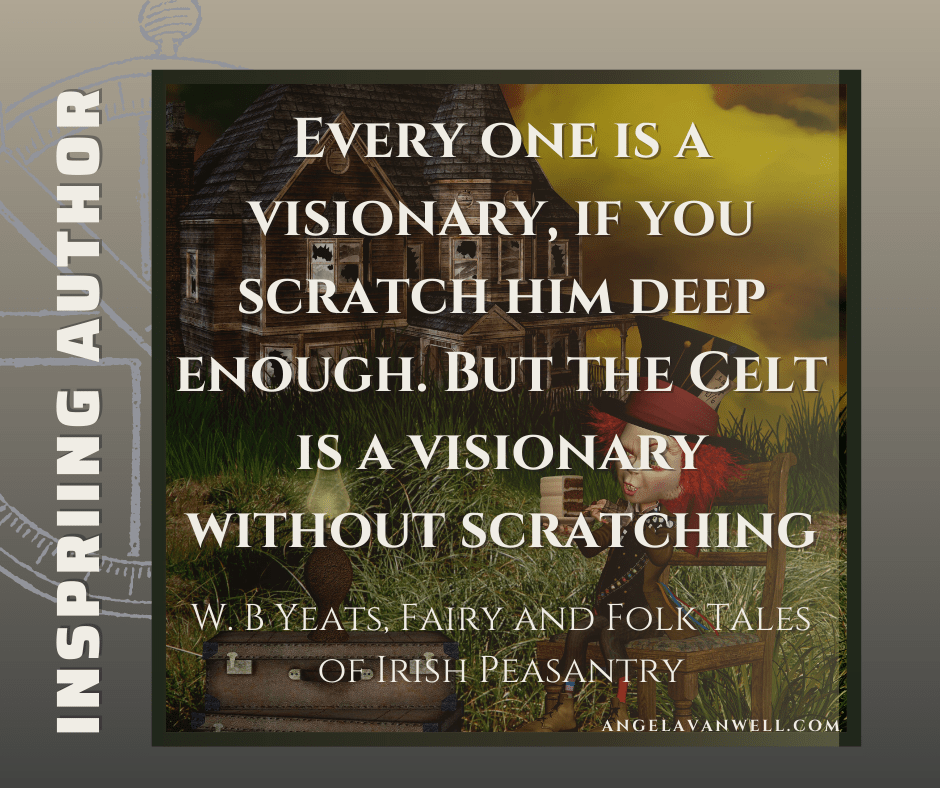
Would you cross, let alone build, on a fairy ring? Do you plead with the elemental powers to take your love away? Have you heard the faery cry, inviting you to come away from the world filled with sorrow? William Butler Yeats explored the oral history of Ireland and added to it. He was an Irish poet, was born into an artistic family, surrounded by artists and poets. His early works focused on Irish mythology and folklore as he was one of the artists responsible for the Irish Literary Revival and creation of the Dublin Abbey Theatre.

It is those ancient tales and his accounts of collecting Irish myth and folklore that I appreciate the most. It is not surprising as I love myths and the twists and turns they undergo when used in modern poetry, novels, TV series, and movies. The collection, Fairy and Folktales of the Irish Peasantry, is filled with real-world accounts of encounters with the faery realm.

He listened to the stories of his home countrymen and wrote them faithfully. The collection of stories was a connection to the Irish identity, a unifying piece of his country. He seemed to interpret the faery realm and the realm of the dead. And later, when he moved his focus to mysticism, he sought to find more answers.

Come away, O human child!

To the waters and the wild

With a faery, hand in hand,

For the world’s more full of weeping than you can understand.

W. B. Yeats, The Stolen Child

Yeats wrote Fiary and Folk Tales of the Irish Peasantry in a dreamlike quality. Similar to a ghost story in events shared by individuals who experienced a faery interaction. Many of the events shared were dark and troubling, perhaps a reflection of the times. Children stolen away, changelings left in their place; of the hardships of life and outwitting the faery folk; or a man ending his vices after interacting with faery folk. Stories where Mermen keep souls in cages under the sea, and priests are heroic. A mixture of tales based in late nineteenth century beliefs.

If you would like to read the collection, it is available at Project Gutenberg: Fairy and Folk Tales of the Irish Peasantry by W.. B. Yeats I suggest you read Soul Cages by T. Crofton Croker. It is too long of a short story to share here, but a unique tale of a merman keeping the souls of drowned sailors.

“when I see a good storm coming on, to set a couple of dozen of these, and then, when the sailors are drowned and the souls get out of them under the water, the poor things are almost perished to death, not being used to the cold; so they make into my pots for shelter, and then I have them snug, and fetch them home, and keep them here dry and warm; and is it not well for them, poor souls, to get into such good quarters?”

T. Crofton Croker, The Soul Cages

Excerpt From: “Fairy and Folk Tales of the Irish Peasantry.” Apple Books.

If you are interested in learning more about Yeats’ interest in Irish Folklore and readings of several of his works, The National Library of Ireland is hosting a talk next Friday: National Library of Ireland Talk

I look forward to their view of Yeats’ works and the pieces they will be sharing.

Happy Reading!

Heaven and Fairyland—to these has Biddy Hart given all she dreams of magnificence, and to them her soul goes out—to the one in love and hope, to the other in love and fear—day after day and season after season; saints and angels, fairies and witches, haunted thorn-trees and holy wells, are to her what books, and plays, and pictures are to you and me.

W. B. Yeats, Irish Fairy Tales

Filed Under: Ghost Stories, Inspiring Authors Tagged With: fantasy, folktales, Irish Fairytales, Yeats

A Dream; When Ghosts Rise and Dance with the Fairies

October 28, 2020 by angelavanwell Leave a Comment

Tash, Thevshi, or more commonly know as ghosts, live in a transitional state between this life and their next. They are held to this life by emotions, loving, longing, and revenge. They can hold themselves to this existence or might be held by the sorrow of another. Irish Folklore is ripe with sightings of ghosts and stories shared about their journeys and the truth behind their unrest.

I used to collect folktales as I was interested in the lore of a culture. It provides deep insight into the thoughts and fears of a culture. The reasonings and understandings of why the world is the way it is in song, lore and legend. My first realization of this was during my childhood.

My childhood was spent in North America, I am Canadian but my father’s work moved us around, I grew up with all the standard schoolyard songs, such as “Ring Around the Rosie.” Now as a kid, all it meant to me was we would hold hands, singing and pulling ourselves along, faster and faster, until my friends across the circle were blurs to my eyes, we all yelled out, “WE ALL FALL DOWN,” then we would release each others hands and fall out away from each other. Laying on the group, laughing, and our thoughts spun while were were light headed. It wasn’t until middle school I found out it was about the Great Plague in the 1700s.

Ring-a-ring-a-roses,

A pocket full of posies,

A-tishoo! A-tishoo!

We all fall down.

Londonist

For morbid nursery rhymes to last that many centuries intact, with the original message in the lyrics, is fascinating and horrifying. The history we are taught at school changes based on what is considered most relevant, important in the current times, but the nursery rhymes still hold the warning of death.

And what will come after death? That was not a part of the song but there were plenty of ghost stories told at this time of year to provide me with some ideas. A soul could cause many a problem. wrong some rights, or punish those it felt responsible for its ending.

As an adult I enjoy ghost stories with less gore and more magic. A Treasuring of Irish Fairy and FolkTales includes a whole section dedicated to ghosts. My favourite, so far, is the poem “a dream” by William Allingham, an Irish writer and poet in the 1800s. It is written with the idea that when a soul leaves its body, it can be drawn away by the Fairies.

a dream

And first there came a bitter laughter;

A sound of tears the moment after;

And then a music so lofty and gay,

That every morning, day by day.

I strive to recall it if I may.

WIlliam allingham

I only included the final verse here as I wrote out the full poem in the picture gallery at the top of the blog. It is a soft, clear, lovely poem of loss. The gentleness in which he writes of loss and the hope to see loved ones again remains true. Many religions believe their members will see their families in the afterlife so it is just one step further to be able to see them here once again. With the change of seasons and the end of harvest in the northern hemisphere, the veil weakening and allowing for the movement of ghosts or spirits makes sense.

With Halloween fast approaching, I look at the Celtic historical celebration of Samhain, transitioned into Hallowed Eve, and the modern Halloween, and appreciate how some traditions and songs stay the same, while others are altered to fit currently cultural expectations.

In our family we read ghost stories, watch movies, and eat Mexican food. It is not traditional Canadian Halloween, but we have lived in many places and have created our own tradition.

If you want to explore more stories from Ireland, check out A Treasury of Irish Fairy and Folktales.

So Happy Halloween and Samhain this weekend! May the veil thin and you see your loved ones.

If you would like more information on some of the cultural expectations of October 31st, I suggest you check out the History Channel or the Day of the Dead website.

Filed Under: Ghost Stories, Ramblings Tagged With: Celtic Tradition, Cultural Anthrology, fantasy, Folklore, Ghost Stories, ghosts and spirits in urban fantasy, halloween, Irish Fairytales, Irish Folktales

Footer

Connect With Me

  • Facebook
  • Instagram
  • Twitter

Pages

  • About
  • Blog
  • Contact
  • Home Page
  • Privacy Policy
  • Veiled Shadows
Privacy & Cookies: This site uses cookies. By continuing to use this website, you agree to their use.

To find out more, including how to control cookies, see here: Cookie Policy

Copyright © 2026 · Author Pro on Genesis Framework · Powered by WordPress.com. · Log in

Loading Comments...